Diego Borgsdorf Fuenzalida (b. 2002, Los Angeles, CA) is an experimental ethnographic researcher and textile artist based between Los Angeles and Washington, DC. His work addresses the affective dimensions of post-dictatorship life in Chile and the diaspora, using traditional Andean textile methods and enlisting materials critical in the formation of political violence in South America such as sheep’s wool, copper, and salt. Borgsdorf Fuenzalida’s work has been exhibited at Wolfpack HQ through the Estate of Luchita Hurtado and Lee Mullican, Los Angeles; Glen Echo Arts Park, Rockville, Maryland; IA&A Hillyer Gallery, Washington, DC; Room 3557, Launch LA, and Mile 44, Los Angeles. He was a 2024 Iburra Arts and Research Resident at the natural dye studio Blue Light Junction in Baltimore, and was a 2025 Bresler Artist in Resident at VisArts in Rockville, Maryland. They have published research contributions at the Museo de la Memoria y los Derechos Humanos, Santiago, Chile, and an artist book entitled A House Containing with Wolfpack HQ sold at Artbook at Hauser & Wirth, Los Angeles.
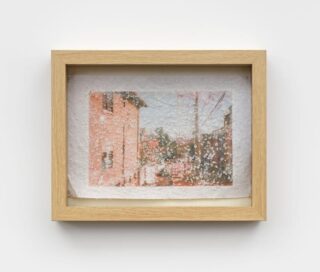
“imposible congelarlo” (2025), photograph of Caleta Abarca, Viña del Mar, Chile on treated 35mm film, printed on salted wool. Courtesy of artist.
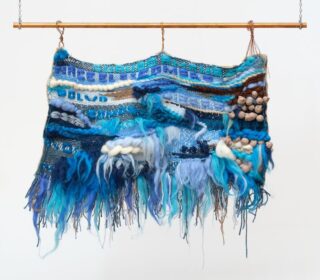
Diego Borgsdorf Fuenzalida, “Rewe tapestry” (2025), wool (sourced from Chile) sucrose indigo, copper, cotton, clay, burlap, polyester embroidery thread, copper pipe. Courtesy of artist.
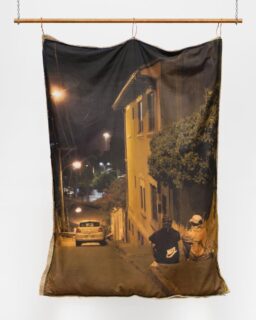
“Siempre te voy a buscar en el pasaje” (2025), photographic arpillera, Photograph printed on cotton, burlap, polyester embroidery thread, poly stuffing. Courtesy of artist.
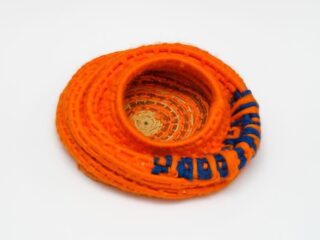
“Tanques que contienen” (2025), Wool (Chile and Argentina) and cotton, fibers hand-dyed with achiote and synthetics. Courtesy of artist.
Artist Statement
The soft sculptures, baskets, weavings, salt crystallizations, quilts, photographic prints, and videos I make are textures. My work materializes what it feels like to live a life in the emergent trans-Pacific Chilean diaspora following twentieth century violence.
Throughout the twentieth century, extractive mining and agricultural projects in Chile spurred violence. Local activism to resist extraction — for example, the movement to nationalize copper production in the 1970s — were met with repression. It is from this history that the Pinochet civic-military dictatorship emerges and brutalizes its opponents. Despite the nation returning to democratic rule in 1990, the economic and political institutions he created live on, and Chileans contend with extreme economic inequality and neoliberal, extractive economics. The roles of critical materials — copper, wool, salt, berries, amongst others — in the formation of these economics continues to be overlooked.
With training in both traditional South American weaving, coming from a lineage of textile workers and copper miners, and museological contexts, I create installations that show how materials can sweep viewers up into the uneasy feelings about history that haunt the trans-Pacific Chilean diaspora.
Our annual group exhibition debuts the work of distinguished 2025–2027 fellows. In this presentation of new.now., each artist’s work conveys a sense of adaptability; some take on an active exercise in troubleshooting.…